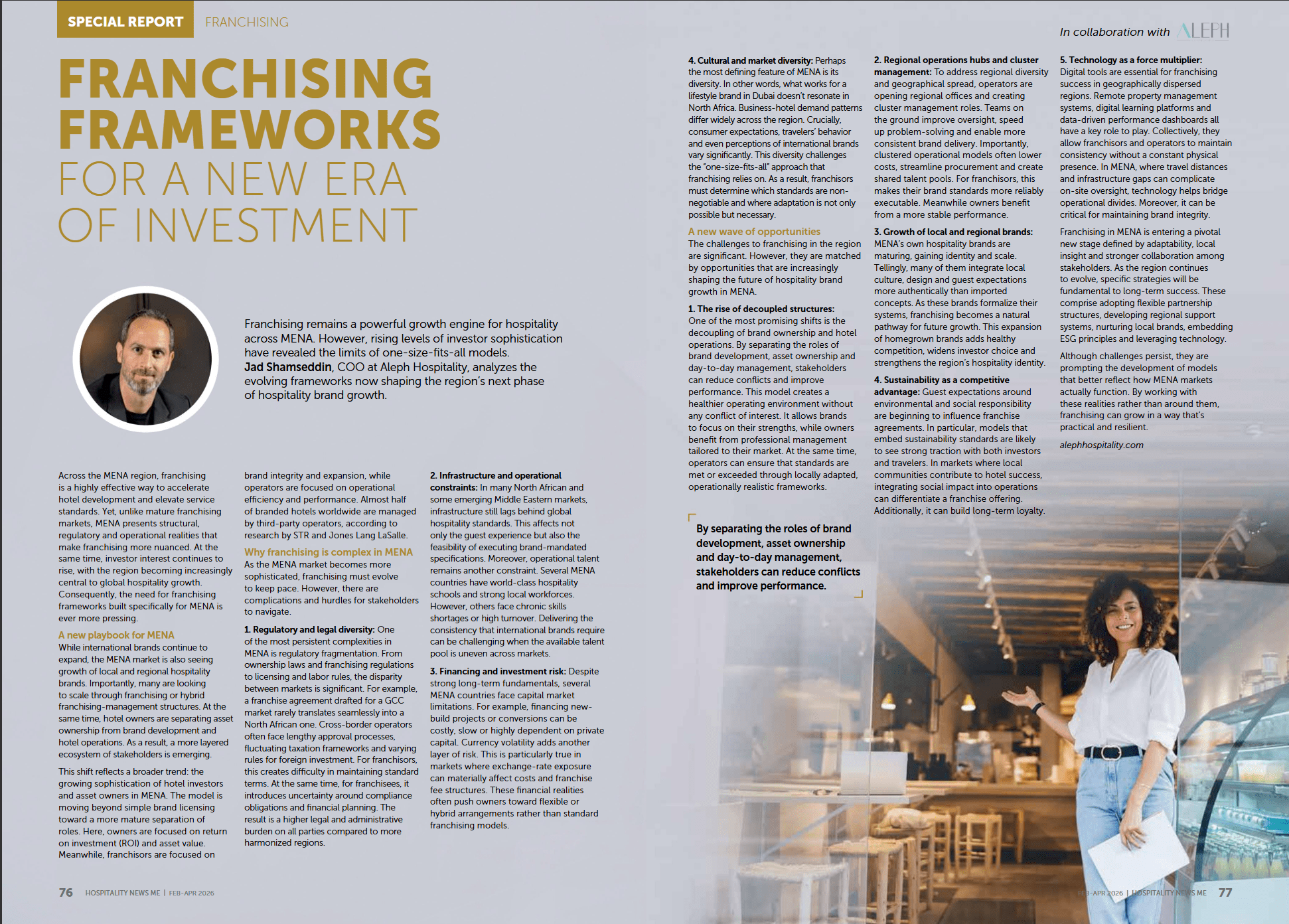
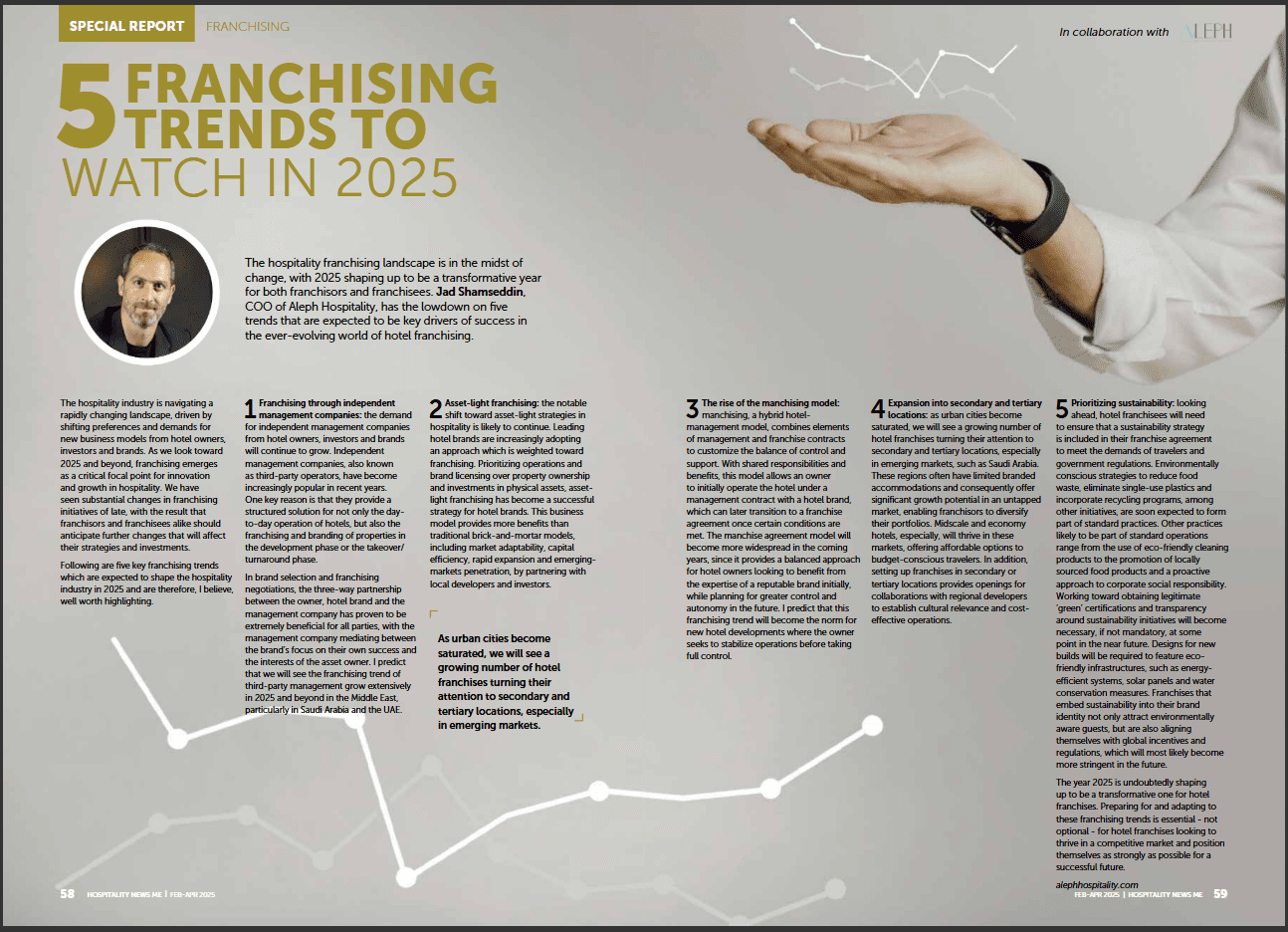
The past decade has seen the rise of new, more flexible models. Manchising, part management contract, part franchise agreement, allows an owner to open under brand management before transitioning to a franchise once performance benchmarks are achieved or a defined period of time has passed. This creates a phased pathway from support and stability to independence. In parallel, independent operators have emerged as pivotal partners, mediating between brands and owners while delivering operational expertise with owner-centric priorities.
The shift toward franchising and independent operators
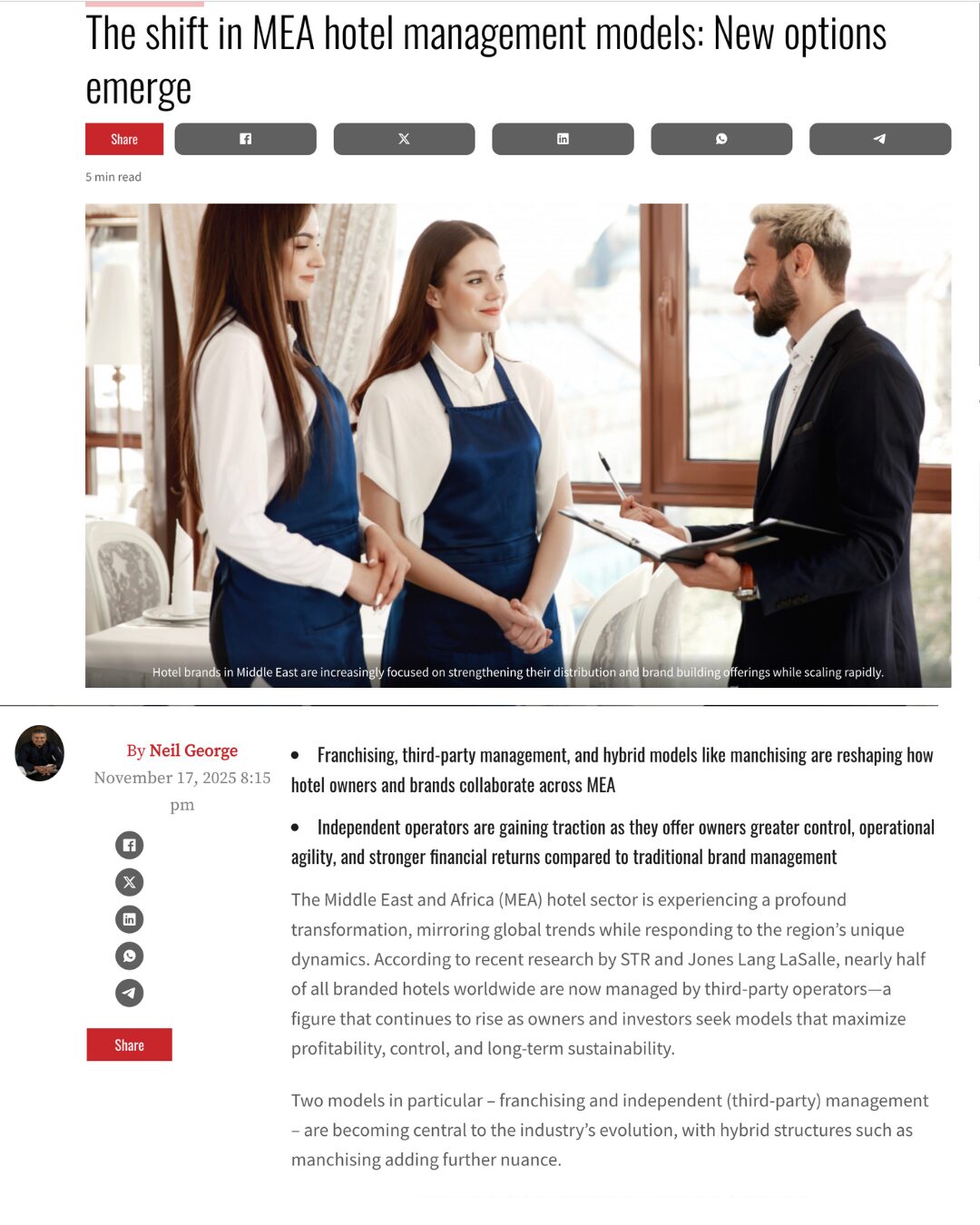
Hotel brands are increasingly focused on strengthening their distribution and brand building offerings while scaling rapidly. This strategy has led to franchising becoming the dominant model in many markets. In the US and Europe, franchise agreements with management by independent management companies already represent the majority of hotel operations – a structure that balances brand strength, owner interests, and operational performance.
The Middle East, while initially slower to adopt this model, is now seeing strong momentum in this direction. Saudi Arabia and the UAE in particular are driving demand for independent management, as sophisticated owners recognize the power of combining the global brand benefits with the benefits of having the management company work for them and under their direction. Rapid sector growth, ambitious national tourism agendas, and large-scale developments have attracted investors who are keen to retain control in asset management but do not want the distraction of day-to-day management.
For these owners, independent operators offer a compelling proposition: expertise across multi-brand environments, in-depth regional knowledge, operational agility, and transparent performance accountability. Their services span the hotel lifecycle from development, brand advisory and pre-opening to day-to-day operations and turnarounds. Owners benefit from shorter, more flexible contracts, tailored services, rigorous, locally-smart cost controls, and a clear alignment of interests. At Aleph Hospitality, our tailored-to-fit management model has delivered 5-10% higher returns for owners compared to traditional management structures. Our owners tell us that what they also value is that that senior management of Aleph are available and responsive to them instantly.
Yet, challenges remain. Owners must cede some operational control (still less compared to brand-managed properties) and pay management fees. Moreover, success depends on the operators’ ability to meet both owner and brand expectations. Nonetheless, the clear alignment of interests between owners and independent operators continues to fuel adoption in the region.
Hybrid and Transitional Models: The Role of Manchising
For some owners, especially those developing new properties, lacking in-house expertise or access to an independent management company, hybrid models like “manchising” offer a phased approach. Under this structure, a property may begin under brand management, then transition to a franchise or independent operator once performance benchmarks are met or a defined period of time has elapsed.
For these owners, independent operators offer a compelling proposition: expertise across multi-brand environments, in-depth regional knowledge, operational agility, and transparent performance accountability. Their services span the hotel lifecycle from development, brand advisory and pre-opening to day-to-day operations and turnarounds. Owners benefit from shorter, more flexible contracts, tailored services, rigorous, locally-smart cost controls, and a clear alignment of interests. At Aleph Hospitality, our tailored-to-fit management model has delivered 5-10% higher returns for owners compared to traditional management structures. Our owners tell us that what they also value is that that senior management of Aleph are available and responsive to them instantly.
Yet, challenges remain. Owners must cede some operational control (still less compared to brand-managed properties) and pay management fees. Moreover, success depends on the operators’ ability to meet both owner and brand expectations. Nonetheless, the clear alignment of interests between owners and independent operators continues to fuel adoption in the region.
While this can provide valuable support during the critical launch phase, it often involves complex contracts and higher initial costs and may delay the full benefits of independent management.
Africa: A Market Poised for Growth
While the Middle East is embracing global best practices, Africa stands out as one of the world’s most promising hospitality investment destinations. Key drivers include:
- A youthful population (60% under 25)
- Rapid urbanization and a growing middle class
- Government incentives and policy support
- Improved air connectivity and visa reforms
- A shortage of quality hotels, offering high-return opportunities
However, to fully realize this potential, Africa must address structural challenges such as political stability, transparent processes, and access to financing. Here too, independent management companies with “boots on the ground” are uniquely positioned to help investors navigate complexity and unlock value.
Capturing MEA’s hospitality upside
The Middle East and Africa present a fascinating contrast. In the Gulf, the shift toward franchising and independent management reflects a market moving toward global best practices, shaped by ambitious growth strategies and a desire for operational excellence. In Africa, meanwhile, the fundamentals of demographics, market demand, and government policy create a powerful investment case that increasingly attracts both regional and international players.
What unites both regions is the need for flexibility and balance. Owners want greater involvement in their assets, brands want to expand rapidly while preserving brand-integrity and independent management companies are filling the gap. Whichever model chosen, the important fact is that hotel investors now have choices available to them.
For investors and owners, the opportunity lies in options that now allow them to tap into the best of both worlds: the global brand awareness and distribution power of a major brand and the locally savvy, responsive independent management company working to optimize their asset.
(The author is Partner & Co-CEO, Aleph Hospitality)
 f
f
 f
f
 f
f
 f
f
 f
f
 f
f
 f
f
 f
f
 f
f
 f
f
 f
f
 f
f
 f
f
 f
f
 f
f
 f
f
 f
f
 f
f
 f
f
 f
f
 f
f
 f
f
 f
f
 f
f
 f
f
 f
f
 f
f
 f
f
 f
f
 f
f